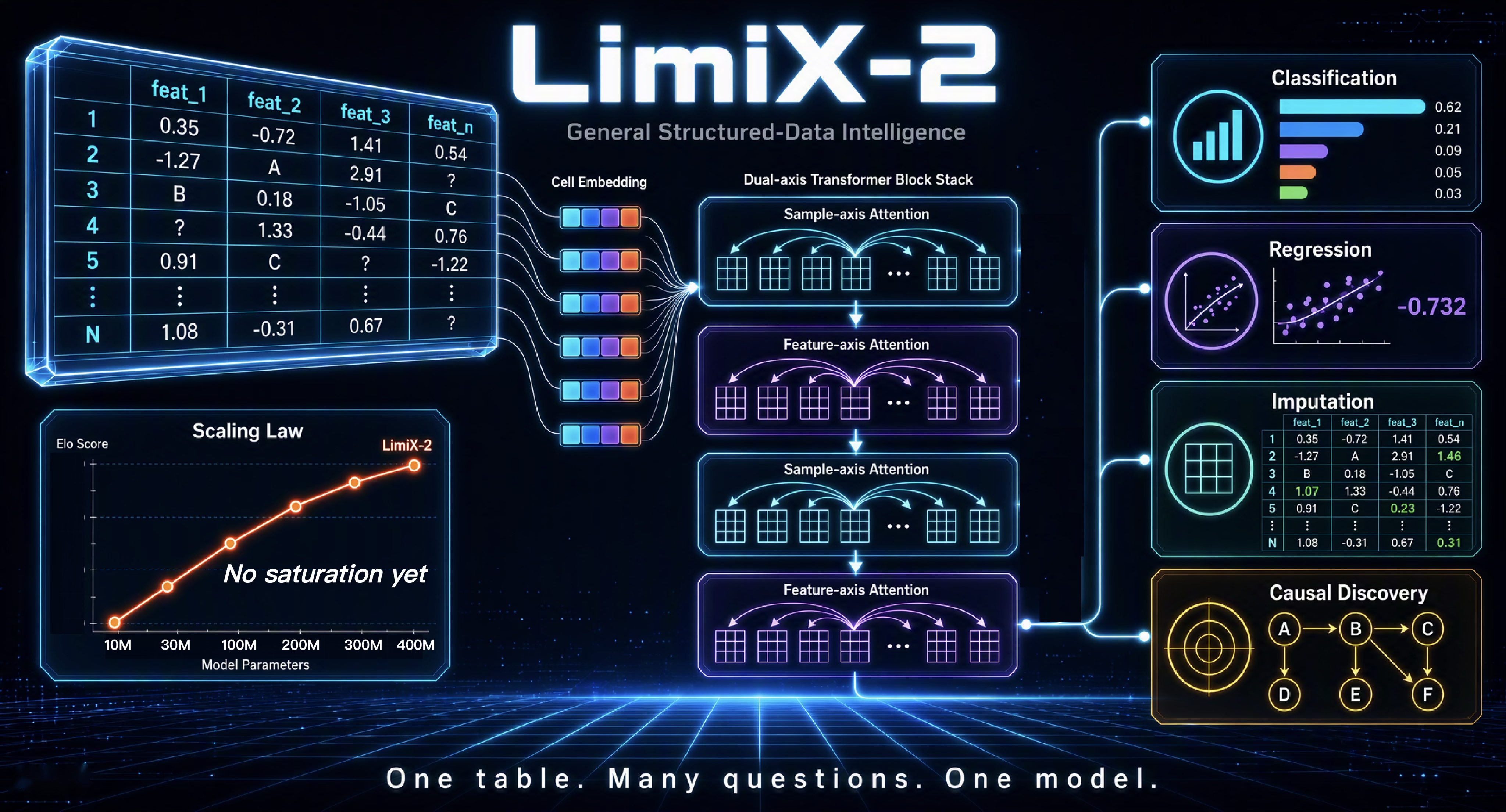
LimiX-2: One table. Many questions. One model.

A Contextual Mechanism Network for General Structured-Data Intelligence

OVERVIEW

Abstract

Structured-data intelligence should be about more than predicting one target column

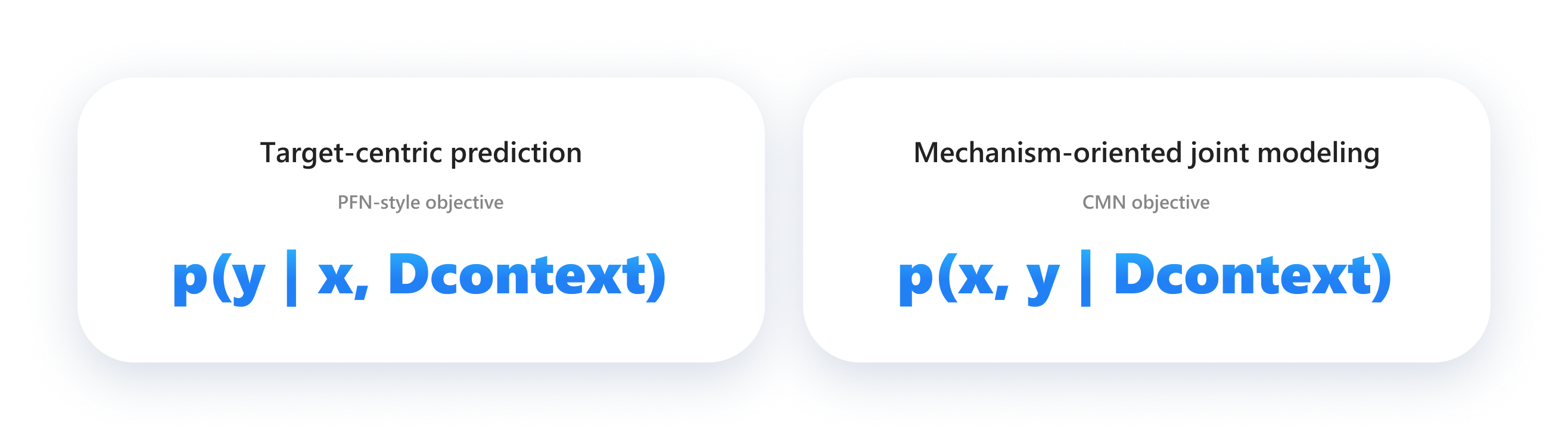
We introduce LimiX-2, a new model in the LimiX family, developed through model and data scaling guided by our previously established scaling laws. LimiX-2 adopts the Contextual Mechanism Networks (CMNs) paradigm and is pretrained with Context-Conditional Masked Modeling (CCMM). CMNs shifts the organizing principle of in-context learning from target-centric prediction to joint modeling. Rather than centering the network on the p(y∣x,Dcontext) objective of conventional tabular PFNs, it is designed around learning p(x,y∣Dcontext), a context-dependent representation of the joint structure underlying data generation. Pretraining uses synthetic datasets generated by structural causal models (SCMs) spanning diverse graph structures, functional mechanisms, and observation processes. Evaluations on TabArena, TALENT, and BCCO show that LimiX-2 outperforms current dataset-specific models and tabular foundation models. Beyond predictive performance, the CMN paradigm also promotes causal awareness in LimiX-2: its feature attention encodes direct causal relationships, enabling accurate causal skeleton recovery.
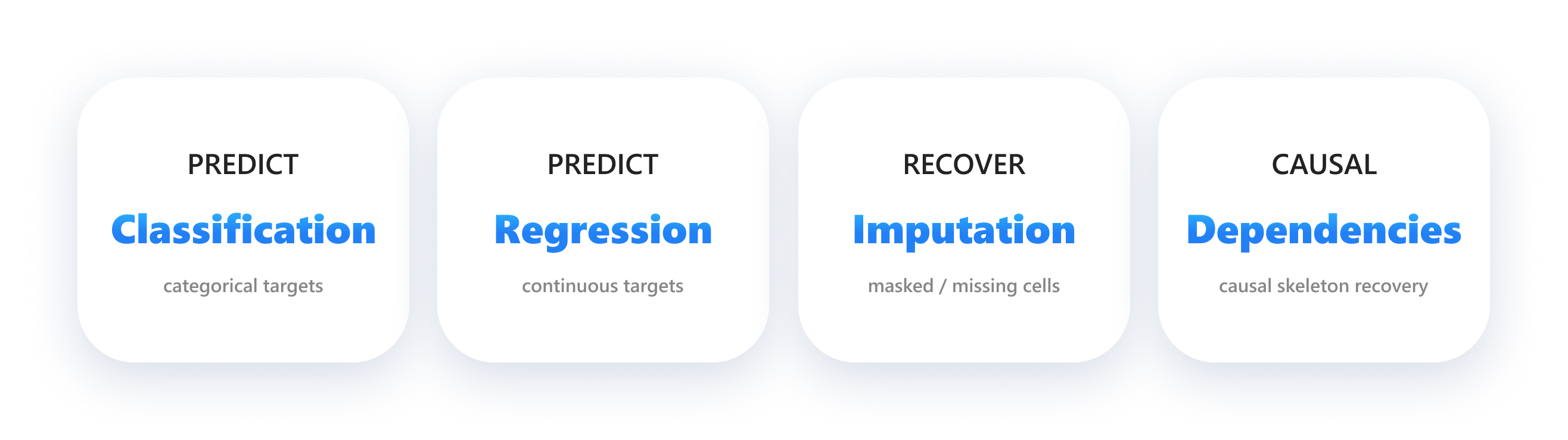
WHAT LIMIX-2 CAN DO
Classification, regression, imputation, and causal skeleton recovery
PERFORMANCE

#1 across all three broad tabular benchmarks

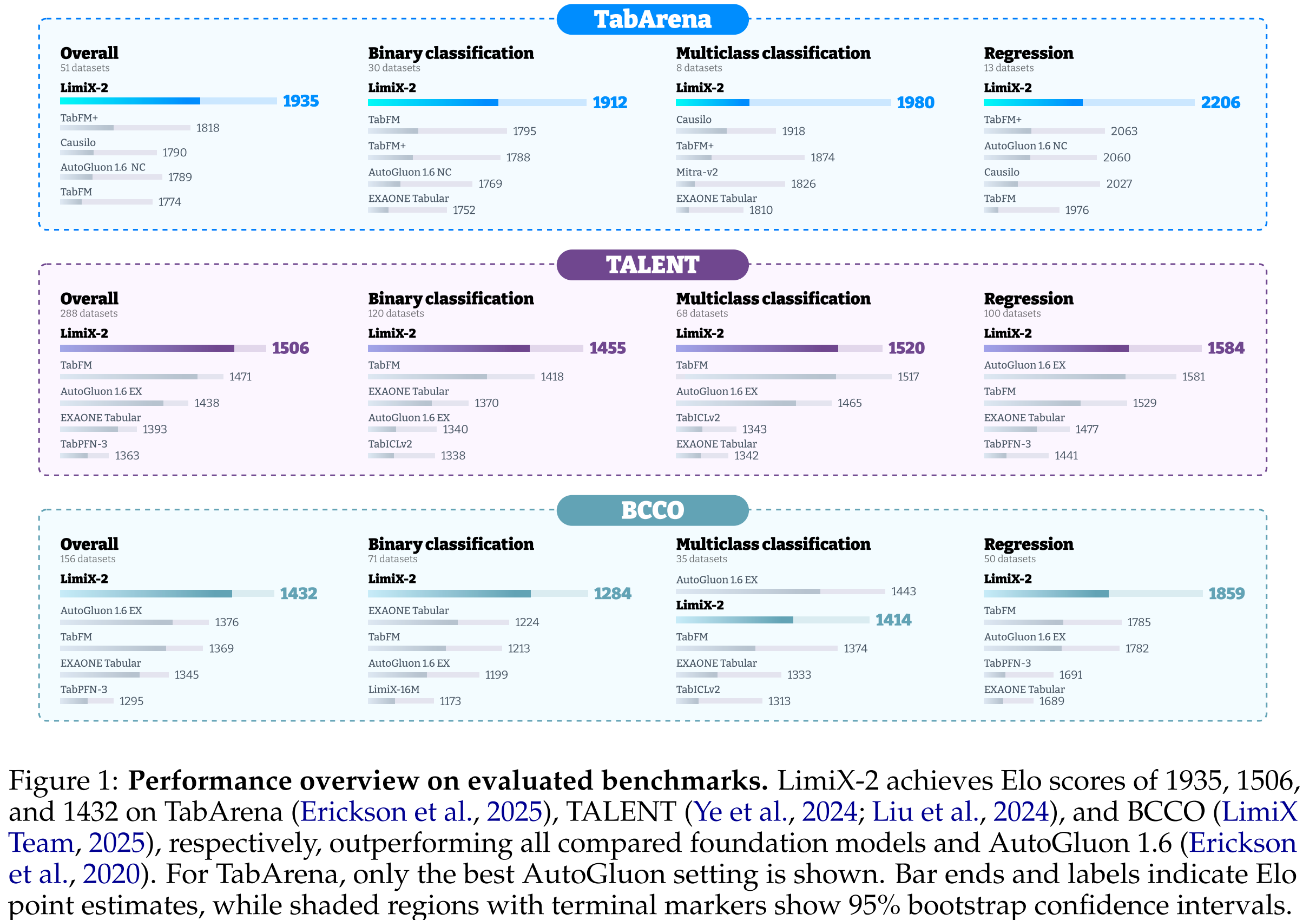
Performance overview on TabArena, TALENT, and BCCO

LimiX-2 delivers consistently strong predictive performance across three broad and complementary tabular benchmarks: TabArena, TALENT, and BCCO. Together, these benchmarks span hundreds of real-world datasets and cover a wide range of classification and regression settings, including variation in dataset size, feature dimensionality, categorical and numerical composition, missingness, and robustness challenges. Rather than excelling in only a narrow subset of tasks, LimiX-2 achieves the highest overall Elo rating on all three benchmarks.

On TabArena, LimiX-2 reaches an overall Elo of 1935, ranking first among all compared methods. It leads not only recent tabular foundation models such as TabFM, TabPFN-3, EXAONE Tabular, Mitra-v2, and TabICLv2, but also strong dataset-specific and AutoML systems. LimiX-2 exceeds the runner-up TabFM+ by more than 117 Elo points before rounding, while also achieving the best average rank and the largest aggregated win count. Its advantage is consistent across both classification and regression: LimiX-2 ranks first across all four predictive metrics reported for the full benchmark, with particularly strong results on the regression subset.

On TALENT, which evaluates a much broader collection of binary classification, multiclass classification, and regression datasets, LimiX-2 again ranks first overall with an Elo of 1506. It achieves the highest Elo across all five reported evaluation categories, including overall performance, classification, regression, binary classification, and multiclass classification. LimiX-2 also records the lowest average rank across binary classification, multiclass classification, and regression, showing that its advantage is not concentrated in a single task family.

The same pattern continues on BCCO, a benchmark designed to stress robustness under challenging and incomplete data. LimiX-2 achieves the highest overall Elo of 1432, ahead of AutoGluon 1.6, TabFM, and other recent tabular foundation models. BCCO is particularly relevant because it includes classification and regression tasks with missing and incomplete features, making it a useful test of whether a model remains reliable outside clean benchmark conditions.

SCALING LAW

Structured-data models scale, too.

Across six model sizes from 12.5M to 406.2M parameters, downstream performance follows clear log-linear trends across all five evaluated series. The consistency of the scaling trends across three benchmark suites and both classification and regression supports a clear conclusion: model capacity is a robust and predictable scaling axis for LimiX-2 within the regime studied. We observe no clear evidence of performance saturation up to 406.2M parameters, providing strong empirical motivation for extending LimiX-2 into the billion-parameter regime.

LimiX-2 model capacity and downstream performance scaling curve
TabArena, TALENT, and BCCO classification and regression scaling results
BEYOND PREDICTION

Structure emerges from attention.

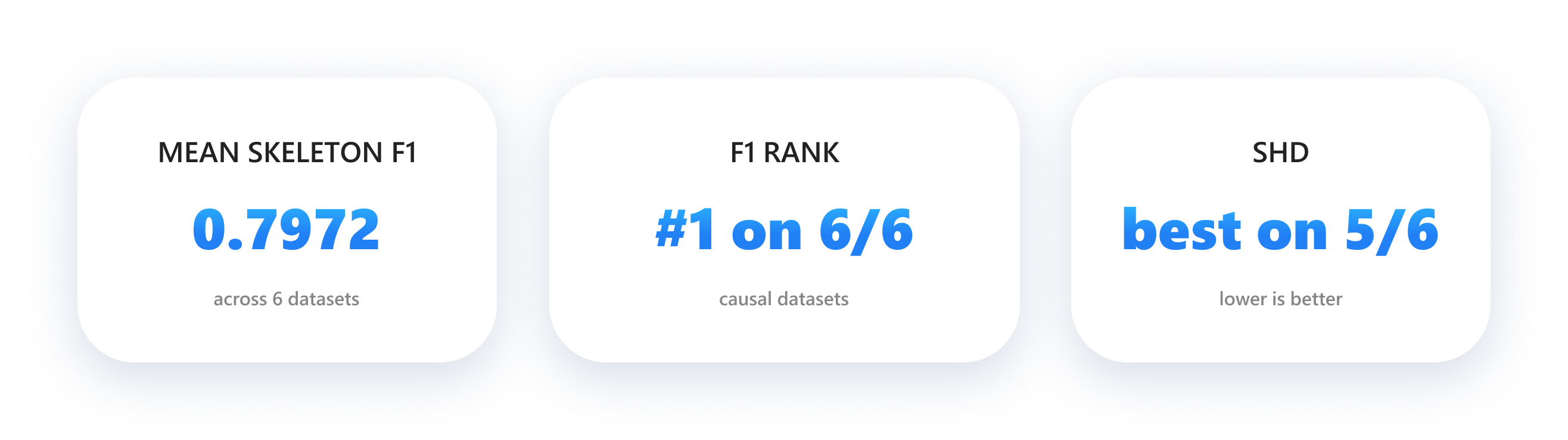
LimiX-2’s feature attention encodes information about direct causal relationships. By probing those attention scores, we can recover causal skeletons from observational data and compare them with known graph structures.

Mean skeleton F1, F1 rank, and SHD
Causal skeleton recovery comparison between LimiX-2 and causal discovery methods

The recovered skeletons match or surpass methods designed exclusively for causal discovery in several settings, suggesting that mechanism-oriented structured-data pretraining can internalize graph-structural information rather than only predictive correlations.

CONTEXTUAL MECHANISM NETWORKS

A table is more than a target column.

Conventional tabular in-context learning is typically organized around a designated target: given features x and a context set, predict y. CMNs broaden this view from a single supervised target toward the system of predictive dependencies among variables.

From target-centric PFN-style prediction to mechanism-oriented CMN joint modeling

CMNs learn from multiple conditional prediction tasks over the same dataset. Context captures the dependencies shared across these tasks, while supervised prediction becomes one special case of inferring unknown quantities from the observed evidence.

From target-centric prediction to mechanism-oriented joint modeling
PRETRAINING OBJECTIVE

Context-Conditional Masked Modeling (CCMM)

CCMM turns each table into many conditional prediction problems. During pretraining, LimiX-2 combines target prediction with masked-feature reconstruction, extending direct supervision across variables and conditioning sets.

Cell masks, column masks, and block masks
CCMM pretraining objective

Interleaving these observation patterns discourages specialization to a single reconstruction setting and gives LimiX-2 a unified conditional interface for classification, regression and missing-value reconstruction — without task-specific parameter updates.

ARCHITECTURE

Cell-level representations with dual-axis reasoning

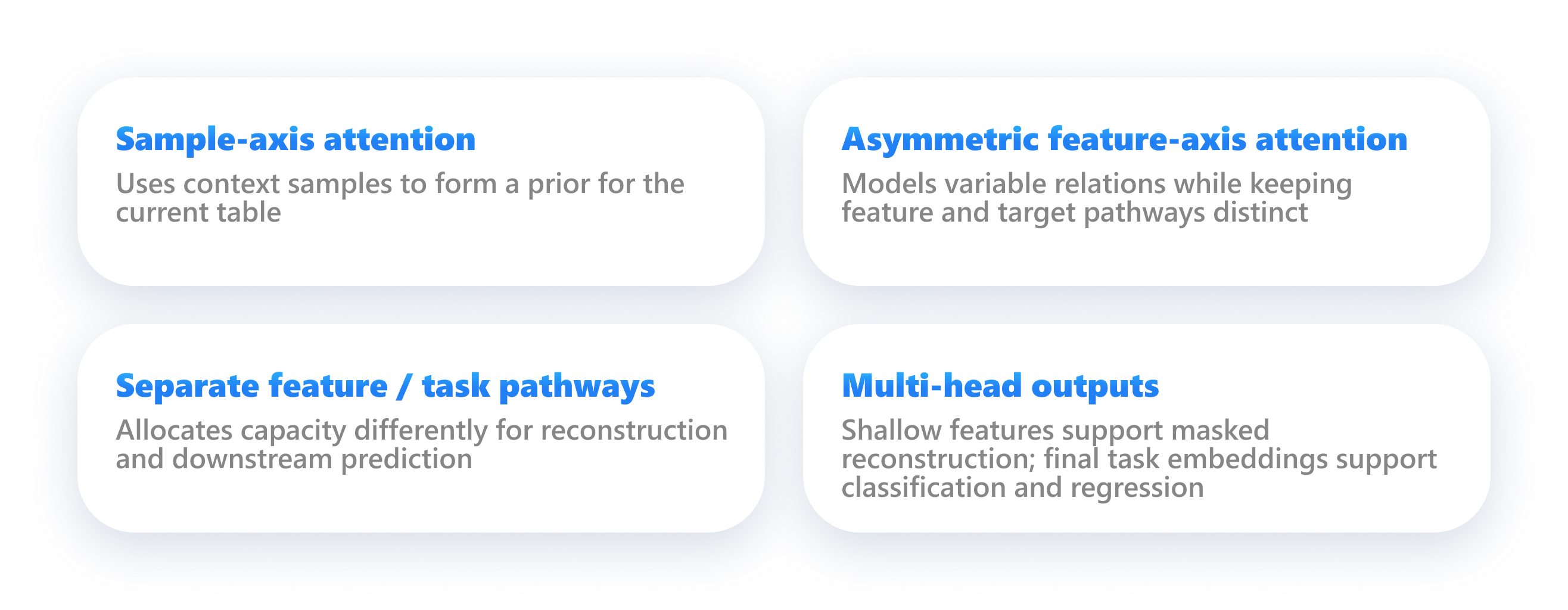
LimiX-2 retains cell-level representations instead of compressing an entire row into one vector. This preserves fine-grained variable structure and lets the model reason across both samples and features.

Sample-axis attention, asymmetric feature-axis attention, separate pathways, and multi-head outputs
PRETRAINING DATA

Synthetic data, structured by mechanisms

LimiX-2 is pretrained exclusively on generated data from structural causal models. The generator spans diverse graph topologies, functional mechanisms, feature distributions and observation processes, expanding both the structural and statistical diversity of pretraining tasks.

Synthetic data generation process driven by structural causal models

Unlike approaches that rely on manually collected and cleaned real-world data, LimiXv2 builds a large-scale automated synthetic data engine. It can generate complex relationships between variables, freely combining linear, non-linear, periodic, and multivariate interaction mechanisms, and further simulate varying data distributions, numerical scales, and class proportions. In this way, during training the model is exposed to data forms far beyond what traditional datasets can cover.

More importantly, this system does more than just "generate data" — it can also automatically construct and filter predictive tasks of different structures, covering classification, regression, missing-value prediction, and other typical scenarios, effectively creating a constantly evolving "data training ground" for the model.

Compared to the previous generation LimiX, LimiXv2 further expands the space of generatable data structures and statistical patterns, freeing the model from relying on memorizing a limited set of data patterns. Instead, it learns more general data regularities through massive variation, thereby significantly improving its generalization and adaptability when facing unseen data, complex business scenarios, and new tasks.

Before the model encounters any downstream benchmark dataset, this training distribution has already exposed LimiX-2 to a vast array of different variable dependencies and observation patterns.

Prediction may be only the beginning.

To what extent can general structured-data intelligence scale